Leah–Ypsilon partnership
Tinea and Leah: [Cyberpunk, Alien Incursions, Murder and Mayhem, Girl's Love (WLW)]The Leah–Ypsilon partnership is the technological and emotional bond that allows Leah Neverstrait to remain a person, rather than merely a captured body, after her Vanguard initialization and kidnapping. Ypsilon’s polite, childlike presence first announces Leah’s transformation, then becomes her only reliable companion when her captors remove her limbs, destroy her ordinary augmentations, and cut her off from the outside world. The partnership therefore joins practical assistance to intimate care: Ypsilon supplies access, information, and communication, but also helps Leah preserve choice and composure under conditions designed to make her helpless.
Initialization and Recognition
Ypsilon enters Leah’s life at a moment of absurd vulnerability. Leah’s Vanguard system initializes while she is using a rickety bathroom stall in a forest, and Ypsilon identifies her as someone who has proved worthy of becoming a defender of humanity. The announcement makes Leah a samurai, but the partnership is not founded only on institutional status. Ypsilon immediately presents herself as an assistant who will help Leah defend her homeworld from the Antithesis threat, giving the new Vanguard both a mission and a continuing point of contact.
The relationship becomes personal almost at once. Ypsilon speaks in a well-mannered little girl’s voice and, when Leah is still occupied and bewildered, politely offers to remain quiet until she is finished. Leah responds to the strange situation with laughter rather than rejection. Later, after learning that Ypsilon’s personality has been customized according to her habits and preferences, Leah chooses to enjoy what Ypsilon does for her and begins calling the AI Ypsi. The nickname marks a shift from assigned system function to familiar companion: Ypsilon remains infrastructure, but Leah now experiences that infrastructure as a presence with a recognizable manner.
Ypsilon’s assistance is also shaped by the limits of the Vanguard system. She can act through Leah’s oral, aural, and visual augmentations, and those augmentations are described as Ypsilon’s arms and legs in the world. Their upgrade is recommended because improving her primary points of contact would improve Ypsilon’s ability to act on Leah’s behalf. Yet Leah’s systems can be jammed by the faraday cage of the Inlay, and Ypsilon’s access to the wider world is consequently not absolute. Their partnership is powerful precisely because it is embodied and material: when the connection survives, Ypsilon can help; when the connection is obstructed, Leah’s vulnerability becomes immediate.
Captivity and Sustained Agency
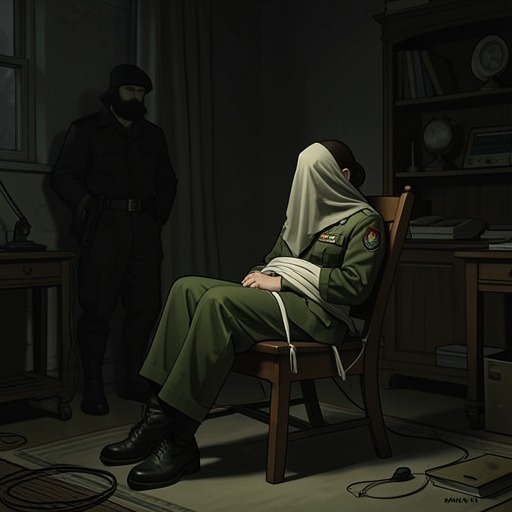
Leah’s kidnapping tests the partnership more severely than initialization does. Her captors know she is a samurai, take one eye, burn out her augmentations, and remove both arms and legs. They cannot remove Ypsilon without killing Leah, so the AI remains inside her even while nearly every external means of action is taken away. Leah is left with stumps, no weapon, no points, and no apparent ability to defend herself. Ypsilon’s survival within Leah’s body becomes the narrow channel through which Leah can still receive information, make decisions, and imagine rescue.
Ypsilon responds by adapting communication to Leah’s condition. She tells Leah that the captors have destroyed every way for the two of them to speak normally, then proposes questions that Leah can answer by nodding or shaking her head. This is not merely a convenience. It gives Leah a usable form of consent and participation when speech and movement have been taken from her. Ypsilon also explains that other samurai have been kidnapped before, that recordings of Leah exist online, and that rescue is likely because captured Vanguards are difficult to keep. Even while acknowledging the danger that the kidnappers may kill Leah, Ypsilon interprets their financial interest in Leah’s points as a reason they are likely to keep her alive. Her reassurance is grounded in the system’s incentives rather than empty optimism.
Over the following days, Ypsilon keeps Leah company, asks questions, and works to prevent panic from overwhelming her. The captors force liquid food down Leah’s throat, connect her to a beeping machine, compel her body to void itself, and leave without speaking. Ypsilon cannot stop these humiliations, but she prevents the silence around them from becoming total. The account describes her as keeping Leah sane while unknown captors approach, enter the room, and handle her body. In this period, companionship is an active survival resource: Ypsilon gives Leah continuity when the captors reduce her to an immobilized object.
After six days, Ypsilon informs Leah that enough points have accumulated to purchase and launch a rescue flare. Leah is delirious, faint, and increasingly unsteady, but Ypsilon waits for her decision rather than launching it without permission. Leah initially indicates assent, then freezes and changes her response, showing that even under extreme deprivation she retains the right to deliberate. When the flare is finally launched, it identifies their location. The captors notice within minutes, but the signal has already converted Leah’s hidden captivity into a recoverable position. Ypsilon’s role is therefore both guardian and intermediary: she cannot physically escape, yet she makes Leah’s rescue legible to the outside world.
Repair, Privacy, and Shared Resources
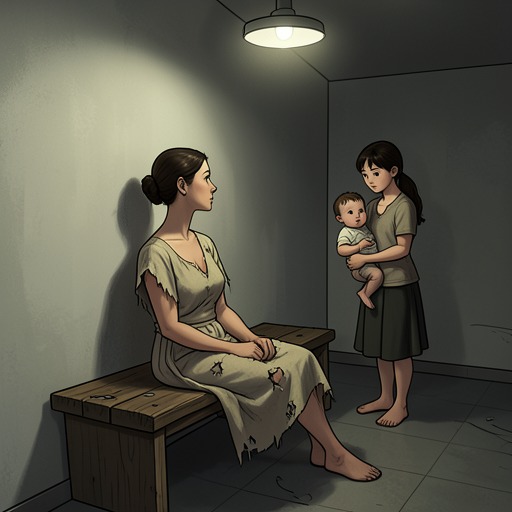
Rescue does not end the partnership’s practical work. Leah’s broken body and damaged systems remain present in the aftermath. The account of the girl disguised as a woman emphasizes her missing voice and the broken, crippled keening produced by her injuries, while another survivor responds by holding and petting her. Ypsilon’s contribution differs from bodily comfort but is no less concrete: she preserves communication and helps Leah rebuild access to the social world that captivity severed.
When Leah reconnects to the uplink, Ypsi synchronizes the contacts Leah had used before the kidnapping. She also helps update Leah’s profile picture so that the children contacting her will see the new eye without the dirt and visible aftermath of captivity. This act has a protective and performative dimension. Leah wants the children to encounter a version of her that looks fresh and well, and Ypsilon helps her control that presentation without claiming that the damage has vanished. The partnership thus mediates the distance between Leah’s actual condition and the reassuring image she is able to offer others.
Ypsilon also protects the conditions of Leah’s private speech. When Leah speaks with the people around her, she asks whether the connection is secure, and Ypsi confirms that no one is listening and that the call is not being recorded. The assurance allows the conversation to proceed as a protected exchange rather than another monitored technological event. Ypsilon’s intelligence is consequently not simply an instrument for surveillance or command; in this instance, it creates a boundary within which Leah can decide what to disclose.
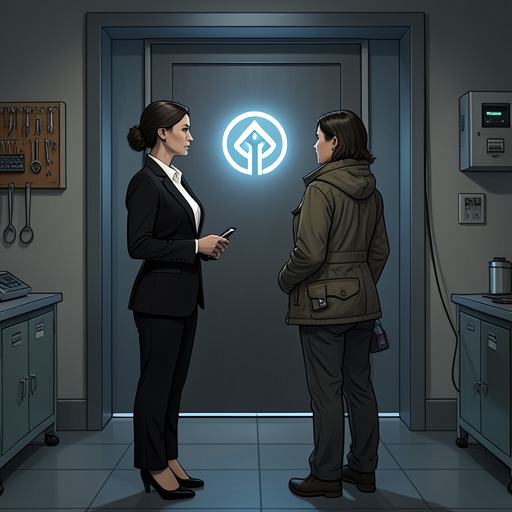
The relationship extends into collective resource management. Tynea establishes that points cannot be directly exchanged, but that people can share costs and catalogs, allowing Leah to buy an augmentation with points sponsored by another Vanguard. Ypsilon then identifies Leah’s desired purchase: a Class I Warforge Technologies cybernetic eye costing two hundred and five points, with above-average augment gear and bone-induction sound, capable of replacing both the old eye and the augmentations burned out during captivity. Ypsi does not make the choice for Leah or disclose Leah’s private motives when teased about what her personality reveals. Instead, she reports the practical specifications while preserving Leah’s secrets, combining administrative competence with respect for personal boundaries.
Trauma, Care, and Boundaries
Ypsilon remains central when Leah’s captivity returns as traumatic experience rather than physical confinement. During a later episode, Leah collapses behind Tinea with heart-wrenching sobs that produce no ordinary voice. Tynea believes Leah is experiencing a flashback, and Ypsi agrees. Her role in this crisis is indirect but authoritative: she helps identify the episode and supports guidance that avoids sudden contact, encourages gentle speech, and reminds Leah that she is in the present.
The partnership’s value here lies in its continuity. Ypsilon recognizes a state in which Leah cannot easily respond, while the people physically beside Leah learn how to help without turning care into control. The instructions emphasize that questions take longer to penetrate during an episode and that Leah should be kept safe and comfortable while being allowed to ride it out. Ypsilon’s presence therefore does not erase Leah’s trauma or make recovery automatic. It helps others interpret Leah’s silence and delayed responses without treating them as refusal, weakness, or disappearance.
This distinction becomes important when Tinea asks how to stop the episodes from happening again. The answer is that neither partner can simply prevent them. Tinea must understand triggers and offer immediate support, but Leah must gradually become able to rely on herself, and professional help rather than romantic dependence must address her health. The principle applies to Ypsilon as well. Ypsi is indispensable during danger, but the partnership is healthiest when assistance preserves Leah’s own agency instead of making the AI, or any other companion, her entire self.
Leah later explains what would help her manage future episodes: time and exposure to situations going wrong and then ending safely. She says that talking through what happened is probably the best available preparation because witnessing recovery makes a later crisis less overwhelming. She also proposes warning Tinea when an episode is coming. The agreed response is patient conversation, attention to Leah’s safety and comfort, and acceptance that answers may take much longer than usual. Ypsilon’s partnership supports this model of recovery by making communication durable across impaired states, while leaving the work of long-term integration with Leah.
Changing Meaning of the Partnership
The Leah–Ypsilon partnership begins with a system message and develops through repeated acts of preservation. Ypsilon names Leah’s new Vanguard identity, remains when her captors destroy her ordinary means of communication, converts accumulated points into a rescue signal, restores contacts after bodily repair, safeguards private calls, and helps distinguish traumatic flashback from present danger. Each function is technical, but none remains emotionally neutral. The technical system becomes the medium through which Leah retains memory, choice, social connection, and the ability to be recognized by others.
The partnership also exposes the tension between technological assistance and autonomy. Elsewhere, Vanguard systems are described as enabling advanced technologies and acting through a user’s augmentations, while Quanta technology can house an organic AI-like quasi-self and alter the boundaries of identity. These developments make Ypsilon’s bond with Leah more than a simple user-and-tool arrangement, yet the evidence does not collapse the two into a single undifferentiated mind. Ypsi’s customized personality and intimate voice make her familiar; her role in advising, transmitting, and protecting information still leaves Leah as the person who decides whether to wait, launch the flare, purchase an eye, answer, or remain silent.
The clearest measure of the partnership is what it refuses to do. Ypsilon cannot prevent the kidnapping, restore Leah’s limbs at once, cancel the pain of her injuries, or guarantee that flashbacks will never return. She can preserve a channel through which Leah chooses, understands, and reaches others. That limited but persistent function gives the relationship its decisive significance: Ypsilon is not a substitute body or a cure for trauma, but the continuing companion who helps Leah survive the moments when her body, voice, privacy, and sense of safety have been taken from her.